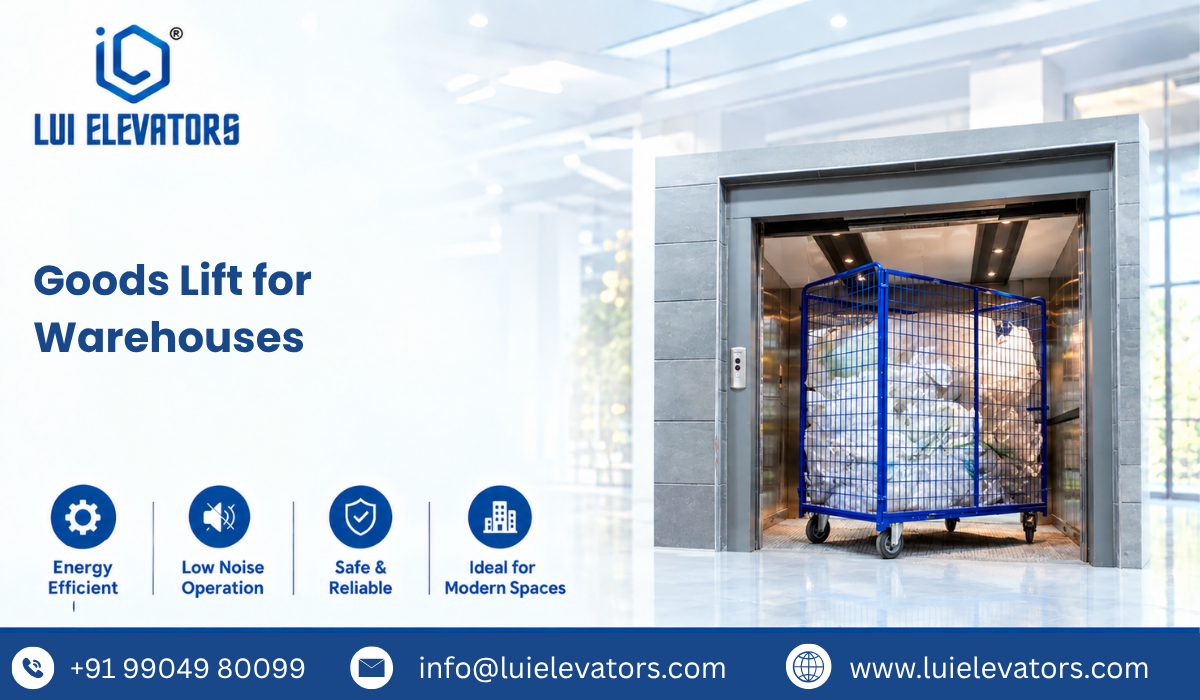
Modern warehouses need fast, safe, and reliable material movement to maintain efficient operations. A properly designed Goods Lift for Warehouses helps transport pallets, cartons, machinery, raw materials, and finished products between multiple floors while reducing manual handling. For warehouse owners, logistics companies, manufacturing units, and distribution centers, choosing the right lift means considering load capacity, lifting height, duty cycle, cabin dimensions, door configuration, safety systems, and available installation space.
Lui Elevators manufactures goods lifts designed for industrial and commercial material-handling applications. Its goods elevator solutions can be customized for different capacities, cabin sizes, speeds, and building configurations. The company offers both Machine Room-Less (MRL) and conventional machine-room configurations, helping businesses select a system suited to their building and workflow.
A Goods Lift for Warehouses is designed specifically for vertical transportation of materials rather than normal passenger movement. In a multi-level warehouse, it can connect storage floors, loading areas, mezzanines, production sections, and dispatch zones.
The right lift can improve material flow by reducing unnecessary movement through stairs or ramps. Wide doors and appropriately sized cabins also make loading and unloading easier, particularly when goods are moved using pallets, trolleys, or other handling equipment.
Lui Elevators focuses on robust construction, customizable cabin configurations, heavy-load performance, and reliable operation for warehouses and industrial environments.
When selecting a Top Goods Lift for Warehouses, buyers should evaluate the complete system rather than focusing only on lifting capacity.
The lift should be engineered to withstand frequent loading cycles and demanding industrial conditions. Strong structural components, durable cabin materials, and suitable flooring contribute to long-term performance.
Warehouse operations often involve bulky packages, cartons, equipment, and pallets. Wide-opening doors and customized cabin dimensions can simplify loading and unloading.
Depending on the project, traction-based systems can provide smooth and controlled movement. Advanced controls can also support accurate floor positioning and dependable operation.
Efficient drive systems can help control electricity consumption while maintaining the required lifting performance. The appropriate system should be selected according to load, travel height, usage frequency, and building configuration.
Safety is one of the most important considerations when purchasing the Best Goods Lift for Warehouses. Depending on the configuration, safety provisions may include overload protection, emergency communication, automatic rescue devices, re-levelling, phase-failure protection, short-circuit protection, door sensors, and unintended-car-movement protection.
For businesses searching for a Goods Lift for Warehouses in Ahmedabad, Lui Elevators provides locally manufactured goods-lift solutions from its Ahmedabad facility. The company states that its goods lifts are manufactured using premium-grade materials and modern technology for industrial and commercial applications.
A Goods Lift for Warehouses in India should be selected according to the actual application. Important factors include:
Proper application-based design can help prevent over-specification while ensuring the lift performs reliably under daily warehouse conditions.
Quality is more than the external finish of a lift. It includes structural strength, component selection, control accuracy, safety systems, installation quality, and maintenance support.
Lui Elevators states that its goods elevators comply with applicable safety standards, including the IS 14665 series and IS 15259 safety requirements for electric traction goods lifts. Its published safety features include overload protection, emergency communication, automatic lubrication, re-levelling, pre-opening, UCMP, and electrical protection systems.
For warehouse owners, working with an experienced Goods Lift Manufacturer for Warehouses can make the specification, installation, commissioning, and maintenance process more systematic.
Before you Buy Goods Lift for Warehouses, prepare accurate information about your material-handling requirements. Start by identifying the heaviest load and the typical load handled during daily operations. Next, determine the required cabin size, number of floors, travel height, and expected number of trips per hour.
It is also important to consider how goods enter the cabin. Forklift or trolley-based loading may require a different door and cabin arrangement compared with manual carton loading.
A professional Goods Lift Supplier for Warehouses should evaluate these requirements before recommending a configuration. Customization can include cabin dimensions, doors, speed, capacity, controls, and other project-specific requirements. Lui Elevators highlights customizable cabins, doors, capacities, and designs for different goods-transport applications.
The Goods Lift Price for Warehouses depends on several technical and installation factors rather than one standard figure. Capacity, number of stops, lifting height, cabin size, drive system, door configuration, shaft requirements, controls, safety equipment, installation conditions, and customization can all influence the final quotation.
Therefore, comparing suppliers only on initial price may not provide a complete picture. Buyers should also consider durability, energy consumption, maintenance requirements, spare-parts availability, warranty terms, installation expertise, and after-sales service.
Lui Elevators provides installation, maintenance, AMC, and modernization services, supporting customers beyond the initial equipment supply.
Lui Elevators is an Ahmedabad-based elevator manufacturer and supplier offering goods lifts for warehouses, factories, storage facilities, logistics centers, retail environments, and other industrial applications. Its published product information emphasizes heavy-load capability, durable construction, space-efficient options, smooth operation, customizable cabins and doors, and safety-oriented controls.
Businesses looking for a Goods Lift Exporter for Warehouses can also evaluate the manufacturer's ability to provide documentation, technical specifications, installation support, and long-term service. A complete solution helps ensure that the lift remains suitable as warehouse operations grow.
Lui Elevators serves customers across major industrial and commercial markets, including
This broad service reach makes it easier for businesses to discuss project-specific requirements with an experienced Goods Lift Manufacturer for Warehouses.
A goods lift is primarily designed to move materials, equipment, products, and other loads vertically between floors in warehouses, factories, commercial buildings, and storage facilities.
Yes. Depending on the project, cabin dimensions, capacity, doors, speed, controls, and other specifications can be customized to suit the application.
Yes, appropriately engineered goods lifts can be designed for heavy industrial material transportation. The required capacity should be determined from the actual load and operating conditions.
Contact Lui Elevators with your required capacity, number of floors, lifting height, cabin dimensions, door requirements, and application details. The manufacturer can then recommend a suitable configuration and provide a project-specific quotation.
A reliable warehouse lift can improve material flow, reduce manual handling, and support safer movement of goods across multiple levels. From engineering and customization to installation and maintenance, selecting the right manufacturer is essential for long-term performance.
If you are planning a new warehouse, expanding an existing facility, or upgrading your material-handling system, contact Lui Elevators to discuss your requirements and find the right goods-lift configuration for your application.

+91 63570 09292
info@luielevators.com
D-16,20,21 Swarnim Industrial Park, Phase-2, Bakrol - Bujrang, Ahmedabad-382430