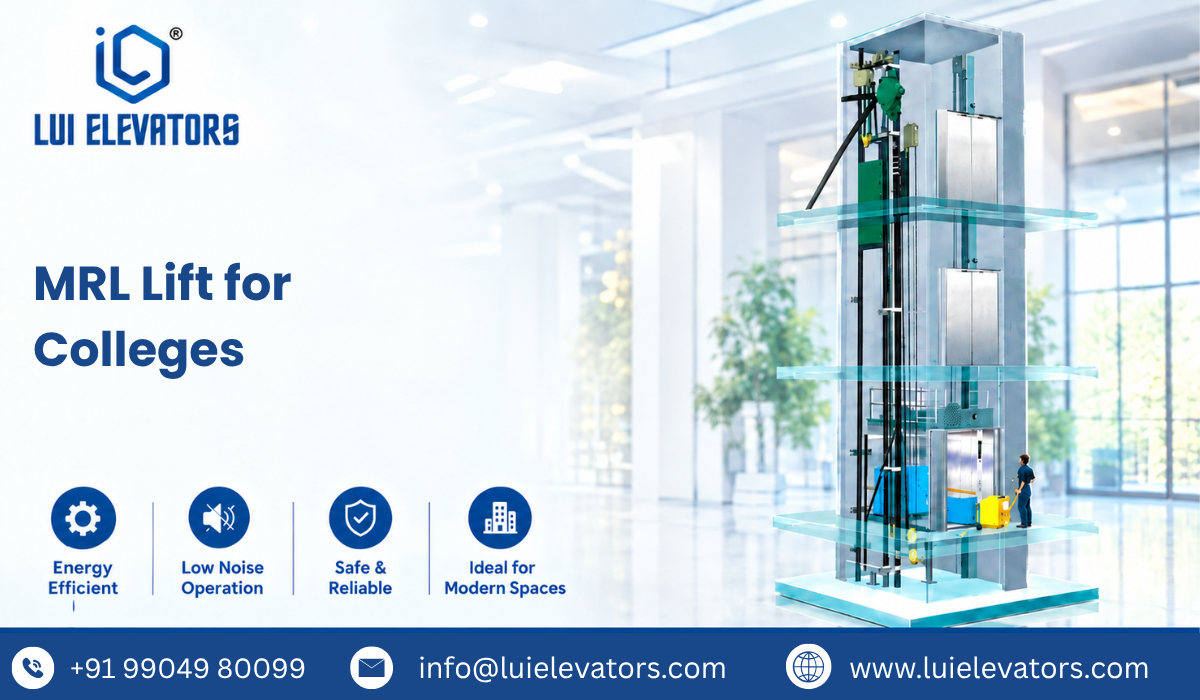
Modern colleges and educational campuses are becoming increasingly vertical, with multi-storey classrooms, laboratories, libraries, administrative offices, auditoriums, and student facilities. As buildings grow taller, safe and efficient vertical transportation becomes essential. A well-designed MRL Lift for Colleges offers a practical solution by combining modern traction technology with a space-saving machine-room-less design.
Unlike conventional elevators that require a separate machine room, MRL technology integrates the traction machinery into the lift shaft. This helps optimize building space while providing smooth, reliable, and comfortable passenger movement. Lui Elevators offers modern MRL elevator solutions that can be planned according to the building's capacity, floor height, traffic requirements, and architectural design.
College buildings experience heavy passenger movement throughout the day. Students frequently move between classrooms, laboratories, libraries, and activity areas, while teachers, staff, and visitors also depend on elevators for convenient access.
An MRL elevator can be an excellent choice for such applications because it eliminates the need for a traditional dedicated machine room. This gives architects and building owners greater flexibility when planning the available space.
An appropriately designed MRL elevator can provide smooth acceleration, controlled stopping, accurate floor levelling, automatic door operation, and comfortable travel. These features are particularly valuable in busy educational environments where elevators may operate frequently throughout the day.
A modern college elevator should combine safety, comfort, efficiency, and dependable operation. Key features can include:
The machine-room-less configuration helps reduce the additional architectural space required for conventional elevator machinery. This can be useful when designing new academic buildings or upgrading existing structures.
Modern traction systems with VVVF control technology can provide controlled acceleration and deceleration. This improves ride comfort and helps create a more pleasant experience for students, faculty, and visitors.
Efficient traction technology can help reduce unnecessary energy consumption during regular elevator operation. Depending on the configuration, energy-saving functions for cabin lighting and ventilation may also be incorporated.
Accessibility should be an important consideration for educational institutions. Depending on project requirements, elevators can be equipped with features such as Braille or tactile buttons, voice announcements, automatic doors, suitable cabin dimensions, and accessible controls.
Safety features can include overload protection, emergency alarm systems, emergency lighting, door sensors, automatic rescue systems, overspeed protection, and other safety-oriented technologies according to the selected configuration and applicable requirements.
Quality plays a critical role when selecting an elevator for a college. Unlike occasional-use applications, educational buildings can have significant passenger traffic during class changes, examination periods, events, and other busy times.
A quality elevator starts with properly engineered components and continues with professional installation, testing, commissioning, and preventive maintenance. The elevator should be selected according to the building's expected traffic rather than simply choosing a standard model.
Lui Elevators focuses on providing elevator solutions designed around individual project requirements. Proper installation and regular maintenance can help maintain ride quality, reliability, and long-term operational performance.
Choosing the right manufacturer is an important part of any college elevator project. A reliable MRL Lift Manufacturer for Colleges should be capable of understanding architectural requirements and recommending an appropriate elevator configuration.
Before selecting a manufacturer, consider:
Lui Elevators can help colleges, educational trusts, architects, contractors, and developers evaluate their elevator requirements and select a suitable MRL configuration.
Educational infrastructure is expanding across India's major metropolitan and developing cities. A dependable MRL Lift Supplier for Colleges can support projects across different regions with appropriate technical consultation, installation assistance, and after-sales service.
The exact elevator configuration should be determined according to the building's location, architectural layout, passenger traffic, number of floors, shaft dimensions, and applicable local requirements.
Educational projects are not limited to major metropolitan areas. Institutions in different regions may require reliable elevator solutions for academic buildings, hostels, libraries, administrative blocks, and other facilities.
An experienced MRL Lift Exporter for Colleges can assist with equipment selection, technical documentation, project coordination, and logistics for suitable markets. Export projects may also require additional attention to local standards, electrical requirements, building regulations, and installation conditions.
The MRL Lift Price for Colleges varies from project to project. There is no single price that applies to every educational building because elevator specifications can differ significantly.
Important factors affecting the overall cost include:
Therefore, colleges should request a customized quotation based on actual project specifications instead of comparing prices based only on basic elevator capacity.
Before you Buy MRL Lift for Colleges, evaluate the elevator as a long-term infrastructure investment. Begin by determining expected passenger traffic and identifying the building areas that require vertical transportation.
Next, review the shaft dimensions, number of floors, travel height, cabin capacity, door size, accessibility requirements, power availability, and desired safety features. It is also important to evaluate the manufacturer's installation capabilities, warranty, preventive maintenance, and after-sales support.
A properly planned elevator can improve campus accessibility while supporting efficient movement between floors for years to come.
Yes. MRL elevators can be suitable for colleges, universities, libraries, administrative buildings, hostels, and other educational facilities. Their space-saving design makes them particularly useful where a separate machine room is undesirable.
Capacity depends on the number of students, expected passenger traffic, building height, number of floors, and elevator usage patterns. A project-specific assessment is recommended before finalizing the capacity.
No. The defining advantage of MRL technology is that the traction machinery is incorporated within the elevator shaft or associated overhead arrangement, eliminating the need for a conventional separate machine room.
Regular preventive maintenance is essential for maintaining elevator safety, performance, ride comfort, and reliability. Colleges with high daily usage should follow a planned maintenance schedule.
Yes. Depending on the project, colleges can select cabin finishes, doors, controls, accessibility features, lighting, operating features, and other specifications according to their requirements.
Lui Elevators understands that educational buildings need elevator systems that balance safety, efficiency, comfort, durability, and space optimization. From compact academic buildings to large university campuses, MRL elevator technology can provide an effective vertical transportation solution.
With suitable engineering, quality components, professional installation, and ongoing service support, Lui Elevators can help educational institutions develop elevator solutions suited to their specific requirements.

+91 63570 09292
info@luielevators.com
D-16,20,21 Swarnim Industrial Park, Phase-2, Bakrol - Bujrang, Ahmedabad-382430