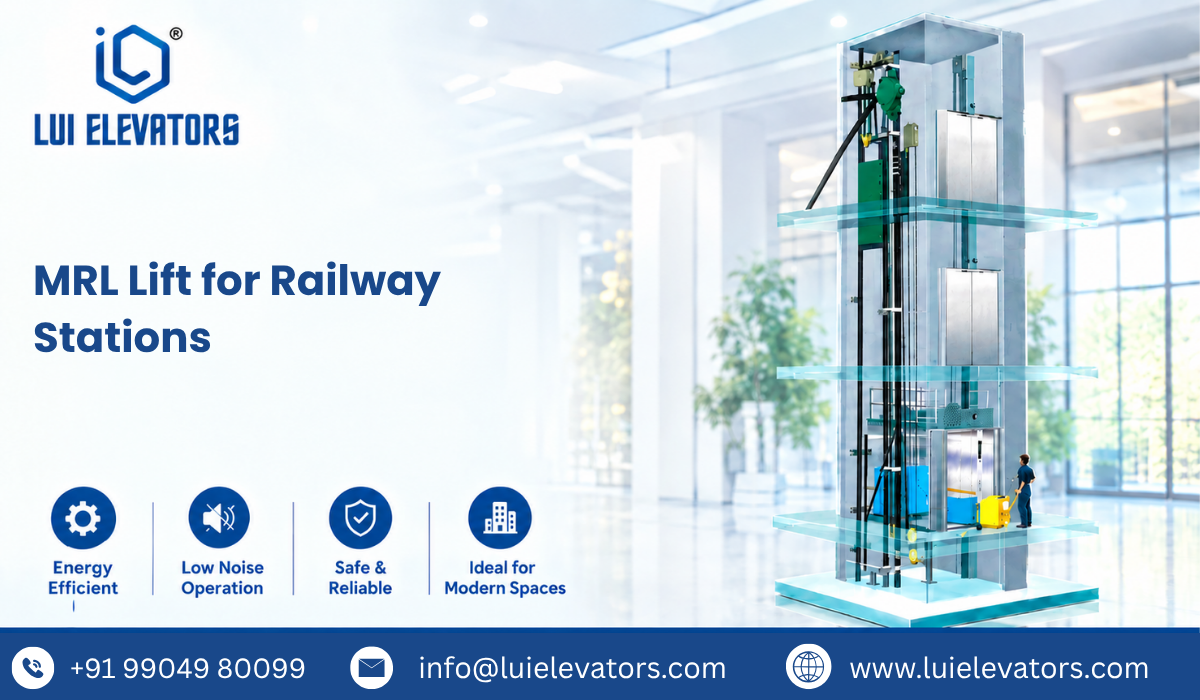
Railway stations are busy public spaces where thousands of passengers may move between platforms, concourses, foot overbridges, waiting areas, and other levels every day. Safe and efficient vertical transportation is therefore an essential part of modern railway infrastructure. An MRL Lift for Railway Stations offers a practical solution for improving accessibility while supporting efficient use of available construction space.
Lui Elevators provides advanced Machine Room-Less lift solutions designed around modern infrastructure requirements. MRL technology eliminates the need for a conventional separate machine room and uses a compact equipment arrangement within the elevator system, subject to project layout and engineering requirements. This can help optimize space while delivering smooth, quiet, and reliable vertical transportation.
For railway stations, lift planning should focus on passenger traffic, accessibility requirements, load capacity, building layout, operating conditions, and applicable safety regulations. A professionally designed MRL Lift for Railway Stations can help create a more convenient travel experience for passengers, including senior citizens, people with reduced mobility, passengers carrying luggage, and families.
MRL stands for Machine Room-Less. Unlike conventional lift systems that require a dedicated machine room, an MRL elevator uses a compact arrangement for its traction and drive equipment within the hoistway or designated overhead area, depending on the project design.
This makes an MRL system particularly useful for infrastructure projects where efficient space planning is important. Modern MRL technology can include gearless traction machines, microprocessor-based controllers, VVVF drives, accurate floor levelling, and intelligent diagnostics.
For railway applications, the lift configuration should always be selected according to the actual project requirements. Factors such as passenger flow, travel height, shaft dimensions, accessibility needs, environmental conditions, and authority requirements must be considered before finalizing the system.
Choosing a Top MRL Lift for Railway Stations requires careful planning. Railway stations experience varying passenger volumes throughout the day, so the lift system must be designed for dependable operation and appropriate passenger movement.
One of the key advantages of MRL technology is that it does not require a conventional separate machine room. This can provide greater flexibility for architects and infrastructure planners while optimizing the available building space.
Advanced traction technology and VVVF control can support smooth acceleration and deceleration. This helps create a more comfortable journey for passengers.
Modern gearless traction systems are designed to offer efficient operation and reduced mechanical complexity compared with traditional geared arrangements. Lui Elevators highlights energy-efficient MRL solutions as part of its vertical transportation range.
Precise floor levelling is important in public infrastructure because it helps passengers move in and out of the lift comfortably.
Railway stations already have high levels of environmental noise and activity. A modern lift system with smooth and controlled operation can contribute to a better passenger experience.
Microprocessor-based controllers can support intelligent operation, diagnostics, and monitoring features depending on the selected configuration.
Selecting the Best MRL Lift for Railway Stations means giving serious attention to quality, engineering, installation, and long-term service support. Railway lifts are part of essential public infrastructure and should be planned for their intended duty and operating environment.
At Lui Elevators, quality and reliable vertical mobility are important priorities. Its MRL solutions are designed to provide benefits such as efficient space utilization, smooth operation, and modern technology.
A well-planned railway station lift project may include consideration of:
Final specifications should always be determined according to the station layout, passenger requirements, applicable standards, and statutory approvals.
Ahmedabad continues to develop its transportation and public infrastructure. An MRL Lift for Railway Stations in Ahmedabad can be planned for projects that require modern vertical mobility, efficient space utilization, and reliable passenger transportation.
Lui Elevators is based in Ahmedabad and offers MRL lift solutions along with installation, maintenance, and modernization support. Its MRL systems are designed around project specifications and applicable requirements.
For railway and public infrastructure projects, site assessment is an important first step. Engineers should evaluate shaft dimensions, travel requirements, passenger traffic, cabin capacity, entry configuration, and service accessibility before recommending a final solution.
The demand for accessible and efficient transportation infrastructure is increasing across the country. An MRL Lift for Railway Stations in India can support modern station development by providing a compact vertical transportation solution where project feasibility permits.
MRL technology may be considered for different areas within railway infrastructure, such as:
Each application requires its own technical assessment. A lift designed for one station may not be suitable for another because passenger volumes, layouts, travel heights, and local requirements can differ significantly.
Choosing a dependable MRL Lift Manufacturer for Railway Stations is important for project success. Elevator manufacturing involves more than supplying equipment. The manufacturer should understand the complete project, including design requirements, technical specifications, installation conditions, testing needs, and future maintenance.
Lui Elevators manufactures a range of vertical transportation products, including MRL lifts and other elevator solutions. The company focuses on modern technology, quality, and customer-oriented project support.
A professional lift manufacturer should help evaluate:
A trusted MRL Lift Supplier for Railway Stations should provide technical guidance throughout the project rather than simply delivering equipment.
Lui Elevators supports customers with solutions that can include:
Understanding the site and infrastructure requirements before selecting a lift.
Planning lift capacity, cabin features, doors, controls, and other specifications according to project needs.
Proper installation is essential for the safe and reliable performance of an elevator system.
The completed installation should undergo required testing and inspection procedures before operation, as applicable.
Regular maintenance and professional service are important for supporting long-term lift performance.
A reliable MRL Lift Exporter for Railway Stations must understand that infrastructure projects can have different technical specifications and regulatory requirements across markets.
Export-oriented lift projects may require consideration of:
Lui Elevators also presents itself as an MRL lift supplier and exporter, with project-focused solutions for different customer requirements.
The MRL Lift Price for Railway Stations depends on several project-specific factors. There is no universal price because every railway infrastructure project has different requirements.
The overall cost can depend on:
For an accurate quotation, customers should share their project specifications with Lui Elevators. This helps the technical team recommend an appropriate solution instead of providing a generic configuration.
Lui Elevators offers modern elevator solutions with a focus on quality, performance, and customer requirements.
MRL systems can eliminate the need for a conventional separate machine room, helping optimize building planning.
Advanced traction, VVVF control, and intelligent controller technology can support smooth and efficient operation.
Lui Elevators emphasizes quality, safe travel, energy efficiency, and better utilization of hoistway space in its MRL lift solutions.
Every railway station has unique requirements. Lift specifications can be planned according to the actual project.
Professional consultation, installation, maintenance, and modernization support help customers manage their vertical transportation requirements.
If you are planning to Buy MRL Lift for Railway Stations, start by evaluating your project's technical and operational requirements. Share details such as travel height, number of stops, expected passenger traffic, shaft dimensions, and required accessibility features.
The right MRL Lift for Railway Stations can support convenient passenger movement while helping infrastructure planners make efficient use of available space.
Lui Elevators serves customers and projects across major Indian cities, including:
and other growing infrastructure markets in India.
MRL stands for Machine Room-Less lift. It is an elevator system designed without a conventional separate machine room, using a compact equipment arrangement based on the project design.
MRL technology can be considered for railway infrastructure where the project layout, passenger requirements, engineering design, and applicable regulations support its use.
Key benefits can include efficient space utilization, smooth operation, compact design, modern technology, and energy-efficient performance depending on the selected system.
The price depends on capacity, travel height, number of stops, speed, cabin design, doors, safety features, installation requirements, and customization.
Consult a professional elevator company and provide complete project details, including traffic requirements, shaft dimensions, travel distance, accessibility needs, and applicable regulations.
Looking for a reliable MRL Lift for Railway Stations that combines space efficiency, modern technology, passenger comfort, and dependable performance? Lui Elevators can help you evaluate your project requirements and select an appropriate lift solution.
Contact Lui Elevators today for technical guidance, project consultation, and a customized quotation. Choose a smarter approach to vertical transportation and support safer, smoother, and more convenient passenger movement at your railway infrastructure project.

+91 63570 09292
info@luielevators.com
D-16,20,21 Swarnim Industrial Park, Phase-2, Bakrol - Bujrang, Ahmedabad-382430