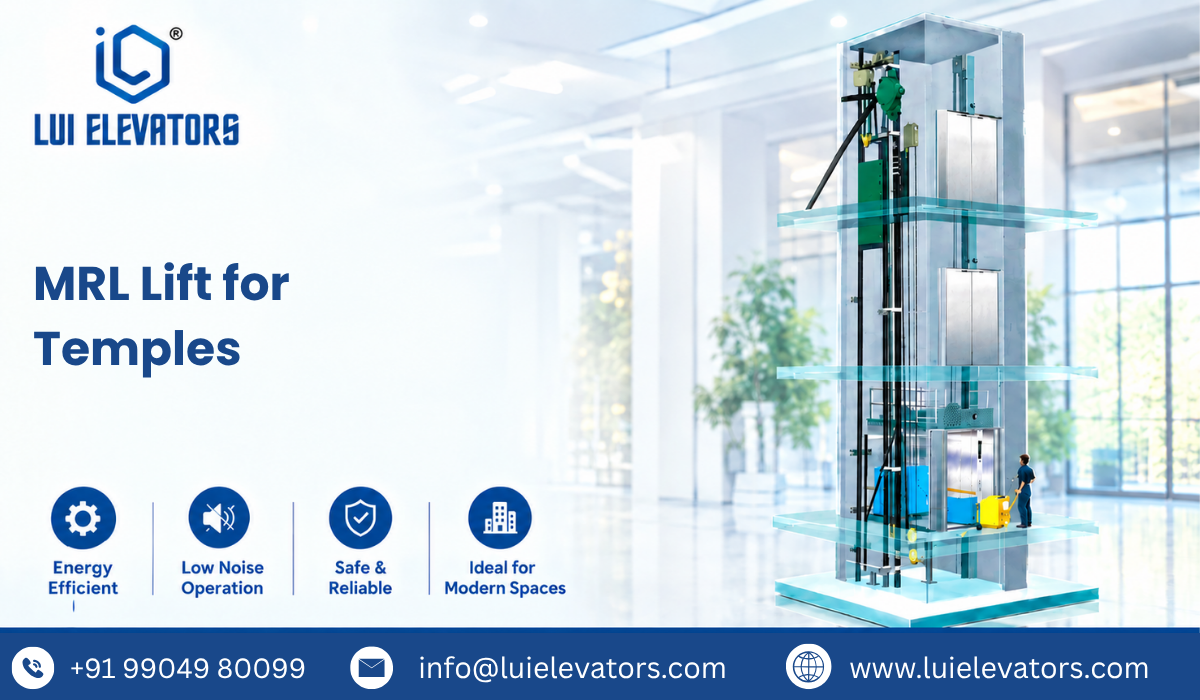
Modern temples are increasingly designed with facilities that make worship accessible and comfortable for devotees of every age. Senior citizens, children, people with mobility challenges, and families often need convenient vertical transportation between different floors. A well-designed MRL Lift for Temples provides a practical solution by combining smooth passenger movement, space-saving construction, safety features, and modern technology. Machine Room-Less (MRL) elevators integrate the traction equipment within the hoistway/overhead zone rather than requiring a conventional separate machine room, helping optimize architectural space.
Lui Elevators develops elevator solutions for different building requirements, with MRL technology offering a strong option for temples, religious complexes, community halls, pilgrim facilities, and multi-level spiritual centers. The right elevator can support comfortable movement while preserving the architectural character of the temple.
A temple has different requirements from a typical commercial building. The elevator should operate quietly, provide smooth acceleration and stopping, and be easy for devotees to use. An MRL Lift for Temples is particularly useful where available construction space is limited because a separate machine room is not required.
Modern MRL systems can incorporate gearless traction technology, VVVF control, automatic doors, accurate floor levelling, emergency functions, overload indication, and optional accessibility features such as tactile or Braille buttons. These features can make daily temple operations more convenient while supporting a comfortable passenger experience.
For new construction, MRL technology can also provide greater flexibility for architectural planning. It can help temple designers maintain a cleaner rooftop arrangement while utilizing the available shaft area efficiently.
A Top MRL Lift for Temples should be selected according to the building's height, expected passenger traffic, shaft dimensions, capacity, duty cycle, and local statutory requirements. Important features may include:
The exact configuration should always be finalized according to the temple's architectural plan, passenger requirements, applicable regulations, and approved engineering specifications.
Safety should be the first consideration when selecting the Best MRL Lift for Temples. Elevators are safety-critical equipment, and professional installation, testing, inspection, and maintenance are essential. BIS guidance emphasizes the importance of following applicable Indian Standards for lift installation and maintenance; BIS specifically identifies IS 15785 for installation and maintenance of lifts without conventional machine rooms.
Quality also depends on the complete elevator system rather than one component. The traction machine, controller, guide rails, car frame, doors, safety devices, electrical system, suspension arrangement, and control functions should be appropriately selected and integrated.
Lui Elevators states that its MRL systems are designed according to applicable standards and project specifications, with final compliance dependent on approved design, installation, testing, and applicable authority requirements. Temple management committees should therefore evaluate both equipment quality and the manufacturer's installation and after-sales capabilities.
For religious projects in Gujarat, an MRL Lift for Temples in Ahmedabad can be specified for compact temple buildings, multi-floor religious complexes, community facilities, and pilgrimage-related structures. Ahmedabad's expanding urban environment makes space-efficient elevator technology particularly useful for projects where every square metre of construction space matters.
Similarly, an MRL Lift for Temples in India can be planned for projects across different regions, provided the elevator is engineered according to the building conditions and applicable state regulations. Temple requirements can vary significantly depending on passenger volume, number of floors, climate, architectural design, and operating frequency.
Lui Elevators can target temple and religious infrastructure requirements across major Indian cities such as
The appropriate elevator specification should be determined individually for each project rather than selecting a standard configuration solely by city.
Choosing an experienced MRL Lift Manufacturer for Temples can simplify the complete project process. The manufacturer should understand site measurements, shaft planning, load requirements, cabin dimensions, door configurations, electrical requirements, installation procedures, testing, and maintenance.
As an MRL Lift Supplier for Temples, Lui Elevators can provide solutions that are planned around the project's functional and architectural requirements. From cabin finishes and automatic doors to accessibility features and control systems, the elevator can be configured according to the temple's practical needs and design expectations.
For organizations managing large religious projects, selecting an MRL Lift Exporter for Temples can also be relevant when elevator solutions are required for projects outside the domestic market. Export-oriented projects may require additional documentation, technical specifications, and compliance considerations based on the destination country.
The MRL Lift Price for Temples depends on several factors rather than a single fixed rate. Capacity, travel height, number of stops, speed, cabin size, door type, cabin finish, control system, safety features, shaft conditions, installation requirements, and optional technologies can all influence the final project cost.
A low initial price should not be the only selection criterion. Temple authorities should compare engineering quality, safety provisions, installation expertise, warranty, maintenance support, spare-parts availability, and expected lifecycle performance. A properly specified elevator can provide better long-term value than a system selected only on upfront cost.
Yes. MRL technology can be suitable for temples where space optimization, smooth passenger movement, and modern elevator functionality are required. Final suitability depends on the building design and project specifications.
Yes. Cabin finishes, door configurations, controls, accessibility features, capacity, and other specifications can be planned according to the project.
Safety depends on proper engineering, quality components, professional installation, testing, inspection, and regular maintenance. Applicable Indian Standards and local lift regulations should be considered during the project.
To Buy MRL Lift for Temples, provide the manufacturer with details such as number of floors, expected capacity, shaft dimensions, travel height, building location, and preferred cabin design. This allows the elevator to be engineered and quoted according to the actual requirement.
A temple elevator should provide more than vertical transportation—it should contribute to accessibility, comfort, safety, and efficient building utilization. The MRL Lift for Temples concept offers a modern solution for religious buildings that need reliable passenger movement without a conventional machine room.
If you are planning a new temple, renovating an existing religious complex, or upgrading accessibility, contact Lui Elevators to discuss your project requirements. Share your building layout, number of floors, passenger capacity, and site details to receive a suitable technical recommendation and project-specific quotation.

+91 63570 09292
info@luielevators.com
D-16,20,21 Swarnim Industrial Park, Phase-2, Bakrol - Bujrang, Ahmedabad-382430